29 May, 2014

Depth & speed instrument installation

It's always hard to decide for the in-hull or thru-hull transducer, but we wanted speed and sea water temperature numbers, so drilling is necessary.
Last week, I've finally completed the installation of the Raymarine i40 Bidata display (PN: E70066) and Raymarine DST800 analog tri-ducer (PN: A22154, made by Airmar) with depth, speed & water temperature readings in single thru-hull assembly. 
The work on it begun since we arrived with the boat and firstly I had to decide the best place for the installation of the thru-hull. I wanted better access to it in case of emergency or when pulling the boat onto the trailer. After drilling the inspection hole and looking around the hull I decided to use the V-berth storage area bellow the mattress where we have the water tank already.

v-berth storage with water tank
view from the new inspection hole
This is a good spot because when you get some water here when you remove the transducer plug, it will stay there and will not travel all around the hull.Then I measured the best location in this storage more than 5 times and checking from the outside for any obstructions from the keel rollers and support pads to keep the transducer out of their path during launching/retrieving onto the trailer.
This is also the most front area where the bottom of the hull is still relatively flat to keep the transducer within 22° deadrise angle.

The major task then awaits me during the installation. I've drilled small the pivot hole to see if it's all good. Then I started drilling the inner layer from inside using the 90mm diameter hole saw. This is just wide enough for the hand to tighten the nut of the transducer and further operations. Then I drilled the same diameter on the fiberglass layer just a few millimeters bellow covering of the chopped lead ballast.

big hole in the inner layers of the boat - you can see the black pieces of chopped lead ballast
At first I thought that the lead ballast is somehow uniform matter, but turned out, it's made from small chopped pieces of lead. That makes sense as you cannot pour hot lead onto the fiberglass.
Anyway, that made the work a little harder because I had to take out some lead and created a dam from a cardboard to temporarily prevent other pieces to visit my hole :-) Lastly I had to drill 51mm hole thru the hull from the outside. I started drilling in reverse to prevent gelcoat chipping and as soon as I drilled thru the gelcoat layer I switched the rotation and finished the hole.

view thru the 2" hole from the outside
You can clearly see all 3 layers. From the left, its the inner layer, ballast cover and the hull. Of course the cardboard is not the best water tight sealant so I had to put 3 layers of fiberglass all around the perimeter between the hull and ballast cover.
Then I used the fiberglass circle I've drilled from the inner layer, drilled smaller 51mm hole and epoxied it to the hull as a backing plate to increase the hull thickness. I've wrapped the thru-hull housing with the plastic bag and screwed it to the hull so the backing plate is parallel with the hull.

fiberglass perimeter, backing plate and the thru-hull housing
sanded glass fibers
This is still not water tight. There are tiny holes in the perimeter fiberglass layer, but also there is still no seal between the hull and inner layer. So I mixed polyester resin with the chopped glass fiber and Cabosil to create a peanut butter like consistency, put into the plastic bag with a tiny hole in one corner and squeezed the resin between the inner layer and ballast cover layer like the confectioner.

final seal with the thickened resin
Then I've used the putty knife to spread the resin all over the perimeter and made it uniform.
As the last step I've just painted the hole with one layer of gel-coat and one layer of top-coat

final hole
In the same time I was drilling the hole for the display in the cockpit bulkhead. Always measure twice and check the surface is as flat as possible. Then drill the pivot hole and measure again.

57mm hole for the display
inside the head
Then it took me some time to think where to install the cabling. At first I wanted to pull it thru the ceiling, but it turned out to be impossible. Then I carved and varnished nice narrow planks of oak to build a conduit for the wires, but then I found out that I can very easily pull the cables between the inner and outer layers from the bulkhead under the seating just to the port cockpit hatch where I have a gas tank. I was so glad and there is plenty of space for other wires.

display and transducer cables in the port cockpit hatch board
going upwards just between the cockpit seating and the inner layer

When I tested the display mounting I've found out that the inner layer bends towards the deck layer so I've added small pieces of wood blocks in between.

transducer and power cables and small wooden spacer
 
Then I've applied two rings of the butyl tape and screwed the display from inside.

butyl tape seal
inner view and cables

final installation
The last task was to bevel the edge of the hole and sand the gel-coat a bit to allow Sikaflex 291i better adhesion.

beveled edge of the hole
applied nice amount of the Sikaflex

finished housing

Now it's all about to insert the transducer plug and off we go.

27 May, 2014

Electrical upgrades

This was the most time consuming task I have done on this boat so far. To install the solar and a motor battery charger, battery monitor and the depth & speed instrument, it took me some weekends pulling cables behind carpeting and various fiberglass layers. I had to use almost all tools I have and weird body positions to sort out this task by myself alone.

First, I had to pull some wires from the cockpit lockers into the distribution panel for battery charging, monitoring and also for the depth sounder, but I will write about this later, because it deserves its own post.

pulling cable from the aft-berth...
...into the head room and then right...
...to the distribution panel
all wires were then hot-glued onto the hull behind the carpeting
Then I've installed the "real" battery monitor Victron Energy BMV-700 which is really great in giving you precise information about the charging/discharging, battery voltage and even the remaining capacity. I've installed it instead of the car lighter socket next to the switch panel.

drill the hole
insert the monitor and simply plug in the cable from the shunt
this the example of properly labeled cable with transparent heat shrink


This is the original wiring behind the switch panel. They are using ordinary and cheap DIN rail-mounted system used for home installations and I believe this is not marine rated. Maybe this is suitable for freshwater environment, but we will see what happens on the sea. If there will be a problem with corrosion I will replace this.

factory wiring using the ordinary DIN rail-mounted system
Then I've replaced the simple analog gauge battery monitor, which was mounted in a strange position to look at anyway, by the 12V car socket. I cut a thin piece of oak to hide the original cutout.


Now get back to the cockpit lockers. Here I've installed the main electrical subsystems. The junction box in the middle is the combining the output of the solar panel and the outboard charging coil. The connection is pretty simple - solar panel has there blocking Schottky's diode to prevent the current from the motor going into the solar cells and a fuse. The outboard motor has the bridge rectifier and the fuse already installed inside the motor so there is no need to add an additional blocking diode or fuse. And finally the MPPT charger has the fuse for the battery already inside.
On the right you can see the battery monitor shunt and bellow there is a main fuse housing.


battery charge, junction box, battery shunt, main fuse
The final complaint about the wiring is the cheap and poorly crimped ring terminals on this main 10mm2 cables. I was almost able to pull out the cable from the terminal!!! Anyway, I've crimped better quality terminal with the proper crimping tool and used the heat shrink to prevent the corrosion.

proper wire terminals
There is still a plenty of space for the main battery charger from the 230V power line. I've bought the smart CTEK M200 charger. This is a marine rated, quiet and very easy to use charger.
We don't have power line sockets on our boat so I will simply use the extension cord and put it into the locker.

Cockpit lockers upgrade II.

I've finally finished the lockers upgrade. Initially I had some issues with the gel-coat color, because the first one I used was slightly off-white, so I've ordered a different which is Vorgelat T35 and is snow white, exactly the same way like the original gel-coat used by the factory.  It's not cheap but very nice to work with. To paint a final coat with a gel-coat you have to add a weak paraffin solution (wax) which help the gel-coat cures into non-tacky and slightly satin finish. This is called top-coat and is very durable and much better than any paint I know of.

Here are some final pictures with the strap for the gas tank.


23l gas tank with the clip-on connector, pump and fuel filter on the hose

This is the place for the batter in the starboard locker.


starboard locker with the 90Ah battery installed

There is still plenty of space in these lockers for additional boat "garbage". The middle cockpit locker is now completely empty for bulk stuff. My wife suggested we can use it as a pool for our kids, I think we have to test it :-)

The next big task was to upgrade certain electrical systems, but I will dedicate a separate article for that.

12 May, 2014

Solar panel mount

We would like to use a compressor fridge on our boat, but that needs some power from the batteries. I've already installed the new charging coil in the outboard, but still we need more power especially during the sunny days. So we decided to install the solar panels around 50W of peak power. On the previous boat we had the solar panel mounted on the top of the cockpit arch, but this small boat does not have it and we don't plan to install it.
The best flat location is the area in front of the companion sliding hatch board so I will give it a try.
There could be just one more issue and that is the shade from the boom. The problem with the solar panels is that when only one solar cell is in the shade or dark the whole current of the panel is degraded. This is why I don't want to mount the panel permanently (I mean new holes in the boat) at this moment. Polyurethane glues are pretty hard to remove so I've searched the net and found the 19mm 3M VHB acrylic double sided tapes 49xx series which are UV and weather resistant.  Declared holding strength is around 6kg for 30cm of the tape which should be enough, since I will use 2x 40cm on the aluminum L-profile which will then hold the 5kg solar panel.

At first wanted some cool marine flat solar panels that could fit the desired area, but they are pretty expensive, but finally I bought the Victron Energy SPP51-12 50Wp polycrystalline panel with the dimensions of 540x670x35mm. As the charger I bought the Victron Energy BlueSolar MPPT 75/15, not cheap, but the best thing about this is that its all encapsulated electronics and suitable for marine use. This charger will be used also for the outboard charging and will be mounted in the new battery compartment in the cockpit.

Here you can see some photos of the installation itself.

back of the panel with the 2x2cm L-profile rails 40cm long and 3M tape installed

deck connected - 3 terminal (4x 1mm2)

Man, cables from the distribution panel to the mast step is almost impossible to pull through. The inner fiberglass is on some places mounted together with the outer skin so tight that it's impossible to install new cables here without drilling some kind of inspection holes. Luckily I was so wise and ordered 2x double line cables as a spare. Factory installed 4x 1mm2 which is too narrow diameter for the DC currents from the solar panel without significant voltage drop. So I put them together in parallel so the final profile is 2x 2mm2. Then I was able to install the 2,5mm2 cable from the distribution panel to the battery behind the carpeting which was not that easy anyway.
The boat is nice as you don't see any screw heads and all looks clean, but installing something additionally is a pain.
cables to the deck connector on the left (on the right is for mast lights)


final connector glued with sikaflex


final placement

screws holds the panel in place

The holes for the M6 screws are just tapped in the aluminum panel frame so the panel can be easily removed and stored inside the boat.
The future will tell how good this installation is but if not, I can move it to somewhere else, probably stern rails, and use the second mast connector for anything else.

Updated 5/20/2016: I've found out, that the deck connector was some kind of a fake cheap copy which lasted only one season. Its contacts totally corroded so I've replaced it. See my upgrade of the solar panels here.

28 April, 2014

Cockpit lockers upgrade I.

The stock boat has the preparation for the battery in the middle cockpit locker. The starboard locker has separate space for a flexible water tank and the port locker is completely empty without any preparation.
Since we don't have a flexible water tank, I decided to enhance the balance of the weight in the cockpit. That means to relocate the heavy 24kg 90Ah battery to the starboard locker and install the 23L fuel tank into the port locker.
This relocation result in a completely free middle locker which can be used for bulky items like fenders, spare anchor and so on.
The problem is that I have to build shelves for this item.

This is a shelf for the battery in the starboard locker made from the marine 10mm plywood:

battery shelf - 10mm plywood
additional support for the battery shelf
shelf in place
I don't have more photos from laminating, so I can only say that I've sanded the gelcoat a bit and then laminated with epoxy and two layers of glass cloth. Then I've painted it with one coat of white gelcoat. I'm now waiting for gelcoat wax (5% paraffin solution in styrene) that will be added into gelcoat and paint the last non-tacky top-coat layer.

one coat of gelcoat of battery shelf

The port side locker is made the similar way with dimensions for this vertical gas tank

23L gas tank

gas tank shelf in the port locker
Then I'm going to attach the holding straps and finalize the electrical wiring - battery shunt, solar and shore power charger.
In the mean time, I've installed some new wires from the 12V switch panel back to the battery for the solar charging and for the battery monitor.

So stay tuned for more soon, hopefully.

Companionway hatch board storage

The boatyard offers the holder for the companionway hatch board behind the toiled as an extra, but as I can build it by myself I wanted to save some money for other options.

Anyway, I get some old piece of oak cut 3 identical pieces and then used a router to do a slot for the board and rounded corner.


This is the final installation as I glued and fastened in place. The holes for the fasteners were then hidden by an oak plugs.


The only problem was to find the similar varnish. The Dalpol uses HERLAC Kontracid D 1173 Q polyurethane varnish with satin finish, but it's hard to find it here and even in a small package, because it's used for mass production finishing. So far I've found that INTERNATIONAL Goldspar Satin gives almost the same finish. I've applied two coats by brush followed by wiping with a clean rag. This give's you almost like spray satin finish.

Alcohol stove installation

My wife loves coffee, so her first question when we planned our boat was: When do you install the stove? Well, it will be used also to cook some delicious meals so it needs to be fast anyway.
Originally we planned to install the propane fancy double cook-top with integrated sink, but then we realized it's too expensive to build it properly according to industry standards and maintain in the terms of propane bottle installation and servicing fees. Yes of course, you can put the bottle in the anchor locker, but it's not allowed there with the anchors and chains and so on. It's simply too risky to have a propane inside the boat.
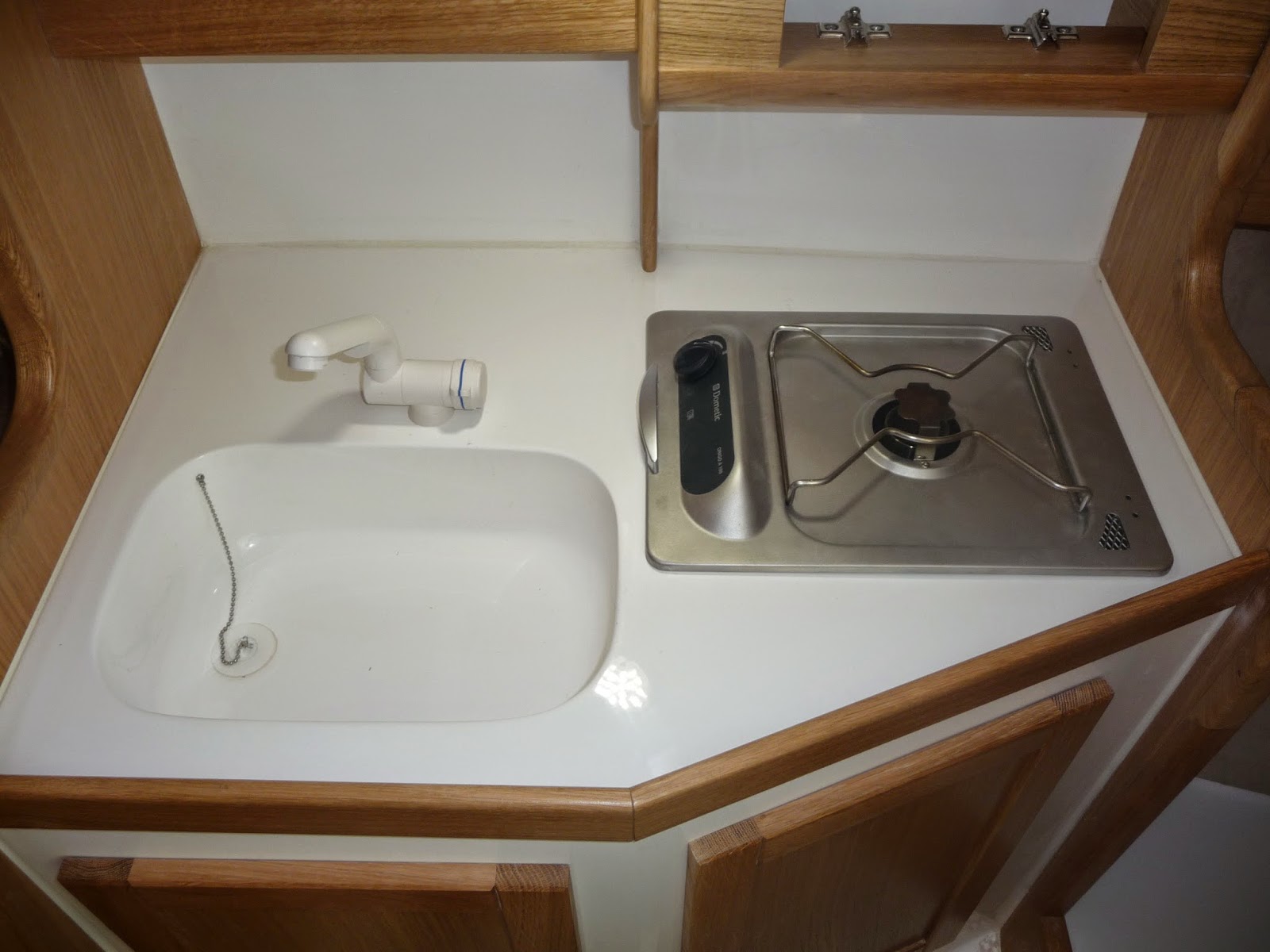
So we choose the other possibility which is an alcohol stove. At first we wanted a double stove, but the galley desk is too small, so we decided for the Dometic Origo A100 flush mount single stove.

The first step was to create a template for cutting the hole needed for the stove. The manual describes an unnecessarily bigger cutout, but I made it just enough for the proper installation.

cardboard template
The next thing was to cut the hole. I drilled pivot holes in the corners and then cut the hole with the electric jigsaw.

final hole with the slot for the magnetic lock
The next problem was the opening hinges. Because I cannot open the stove to a full 90 degrees due to the upper cabinet I was not able to fasten the hinge to the galley. So I added an aluminum L profile to the hinge with the flush mount rivets so the fastening holes are now from the bottom of the galley


closeup of the modified hinge

Next I had to move the position of that holding plate, but that was easy. So now it's almost finished. Just waiting for a gelcoat/topcoat paint of the cutting.


Tadaa... ready for meals... ehm coffee :-)

Inspection hole

Before I can install the depth & speed instrument, I need to drill the inspection hole under the port seating. This is because I will need to see what is really there and mainly to pull through the power and transducer cables. It's also good to have access to this keel area just in case.

Since the boat is in the yacht club, I need to carry all that tools and this is how it looks:


The drilling was pretty straight forward. I simply draw the circle with the diameter smaller by the half width of the drill bit. Then I drilled one 6mm hole to each other. Then I took the metal saw blade to cut the hole and finished it with a smooth file.

measure twice, drill once

dry test of 170mm inspection hole (140 mm hole)

Here you can see through the hole inside the bilge area. The dark color of the bilge area is the encapsulated lead ballast.

key hole view - water inlet and vent & pump feed

centerboard view

The transducer cable will go this way to the sink cabinet in the toilet room:

beautiful eye :-)

final look

24 March, 2014

Upgrades

We are quite busy now with other stuff, but I'm almost finished collecting the new technical and safety equipment for our boat.

One of the last thing is the fridge. We have not decided yet what to choose. This is a pretty small boat, so every free space is a good space, but a compressor fridge is a must. We will probably buy some portable around 20-25 liters and put into the middle cockpit hatch, but first I need to relocate the battery from this hatch to the starboard hatch.
The next thing is to install the fuel tank & hoses, solar panel, battery charger (solar, shore & outboard), battery monitor, depth and speed sounder and a few small accessories. As soon we will get the boat from the dealer's storage, I'm planning to document here all the major tasks.

Spring is getting fast and we can't wait for the first launch.